Designing Falcon So People and AI Share One Understanding
by Yubin Park, PhD, Co-Founder
Most software design principles were written for a world with one kind of user: a person, sitting in front of a screen, clicking through a workflow. That assumption is now wrong. In Falcon, a person and an AI agent work on the same problem, often within the same minute—one reading a chart while the other reads the underlying data, one starting an investigation the other finishes.
That shift changes what good design has to accomplish. A screen is no longer only something a person looks at; it is a shared surface two very different kinds of collaborators reason over. So we wrote down the principles that guide how we build every screen, workflow, and agent behavior across Pulse, Sentinel, Scope, and Helm. We are sharing them here because they explain not just how Falcon looks, but how it is meant to be trusted.
Our north star is simple to state and hard to earn:
Make complex work understandable and actionable. Help people and AI do more together.
Everything below is how we hold ourselves to it.
The three principles, up front
We treat these as a connected constitution, not three independent goals. Each one depends on the others, and the through-line running under all three is this: evidence, understanding, and action should remain connected and legible to both people and AI.
- Make complexity understandable—not invisible. Reduce cognitive load by organizing complexity, not by deleting the evidence, uncertainty, and exceptions people and AI need to interpret the work.
- Keep people and AI grounded in the same work. Both should operate from the same evidence, context, durable records, and current state—so either can understand and continue what the other started.
- Turn shared understanding into responsible action. A finding should connect naturally to its evidence and to a sensible next step, and the result should stay inspectable to whoever comes next.
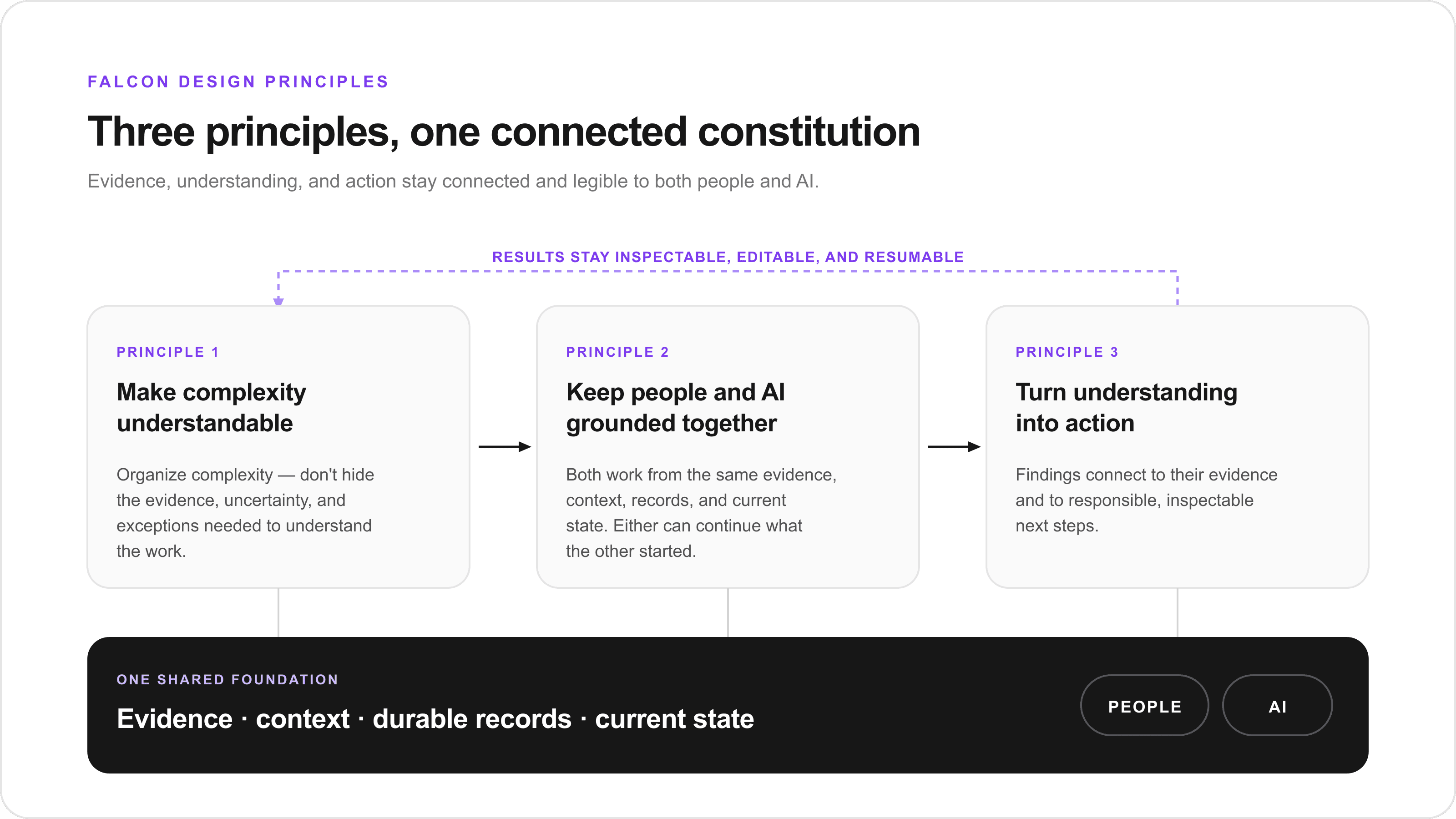
The three principles form a loop on a single shared foundation. Understanding feeds grounded collaboration, which feeds responsible action—and every result stays inspectable, editable, and resumable by the next person or agent.
Why "understandable, not invisible" matters more with AI
The easiest way to make a hard screen feel simple is to hide the hard parts. Collapse the exceptions, round away the uncertainty, drop the provenance. A person might tolerate that. An AI agent asked to continue the work cannot—it has to infer everything that was hidden, and it will infer wrong.
So the goal is to organize complexity rather than remove it. Use meaningful categories, clear hierarchy, familiar terminology, predictable interactions, and structured information. Reveal detail progressively, but keep the complete evidence available when it becomes relevant. A sparse screen can still demand too much if a person has to remember information from three other screens, or if an agent has to guess the scope it was never given.
This is why we favor one clear focal point, purposeful whitespace, and restrained emphasis over grids of equal cards and competing accents. Visual calm is not decoration here; it is what lets both a person and a model tell what matters from what does not.
Grounding people and AI in the same work
The second principle is the one most specific to how Falcon is built. People and AI should work from the same underlying evidence, context, records, and current state—and either should be able to pick up what the other started without reconstructing it.
Concretely, that means carrying the relevant records, filters, period, and evidence through every handoff. When an analyst opens AI from a filtered provider list, the selected provider, cohort, and period come with it, and that scope stays visible—so the analyst never has to restate the question, and the agent never operates on a scope it silently invented. Saved work stays inspectable, editable, and resumable. When information is incomplete or has changed, we say so rather than papering over it.
A person may see a chart while the AI reads its underlying data. That is fine—as long as the scope, values, and meaning agree. Different representations, one shared truth.
Turning understanding into responsible action
Understanding that leads nowhere is a missed opportunity; action disconnected from its evidence is a risk. The third principle keeps the two tied together.
Whenever Falcon presents information, we ask what it helps someone understand, decide, investigate, or accomplish next—and we keep that next step connected to the evidence that motivated it. Move from a comparison to an investigation, from an investigation to a decision, from a decision to ongoing monitoring, and the context should follow you. When work changes a record, the result should be clear and available to whoever comes next.
People and AI may both propose, perform, review, and continue actions—each within the applicable permissions and approval requirements, and consequential actions still need appropriate evidence, review, and confirmation. Importantly, understanding a situation, monitoring it, or deciding that no action is needed is a legitimate outcome too. Not every screen has to end in a button.
From principles to practice
Principles explain the purpose of a design choice; guidance gives the team repeatable ways to achieve it. A few of the connections we lean on most:
| Guidance | What it serves |
|---|---|
| Clear categories, hierarchy, and F-pattern layouts | Reduce human scanning effort without hiding the supporting evidence. |
| Shared components and consistent terminology | Give people and AI predictable concepts and actions, and less to relearn. |
| Semantic structure and shared underlying data | Let people and AI reach the same understanding even when their representations differ. |
| Preserved filters, scope, evidence, and action history | Keep both participants grounded in the same work and able to continue it. |
| Findings connected to evidence and next steps | Turn shared understanding into a decision, a responsible action, or an explicit "no action needed." |
Guidance evolves as we learn; the principles are what stay constant. An F-pattern is a human-oriented default for scanning a dense page, while semantic structure and shared data are what let an agent understand the equivalent work. When a different pattern serves the task better, we explain the tradeoff through the constitution rather than defending the pattern for its own sake.
The questions we ask before shipping
Before designing or reviewing a change, we name the user's task and the next action the screen should make easy. Then we ask:
- What complexity does a person or AI no longer have to reconstruct or remember—and is the necessary evidence and uncertainty still available?
- Can the person and the AI understand the same evidence, scope, state, and prior actions, and continue the same work?
- What responsible next step does this shared understanding enable, and will its connection to the evidence stay inspectable?
- Does the page feel intentional at a glance—clear in hierarchy, familiar in its patterns, calm rather than cluttered—with visible recovery paths when they matter?
- If goals competed, did we favor the user's task, accessibility, and consistency before visual polish or implementation convenience?
These are not abstract ideals. They are the difference between an AI product that feels like a black box and one that a healthcare team can actually trust—because at every step, the person and the agent are looking at the same evidence, reaching the same understanding, and taking action they can both stand behind.
That is what we mean by helping people and AI do more together.